
Geofónie
sound installation
2/11/2024
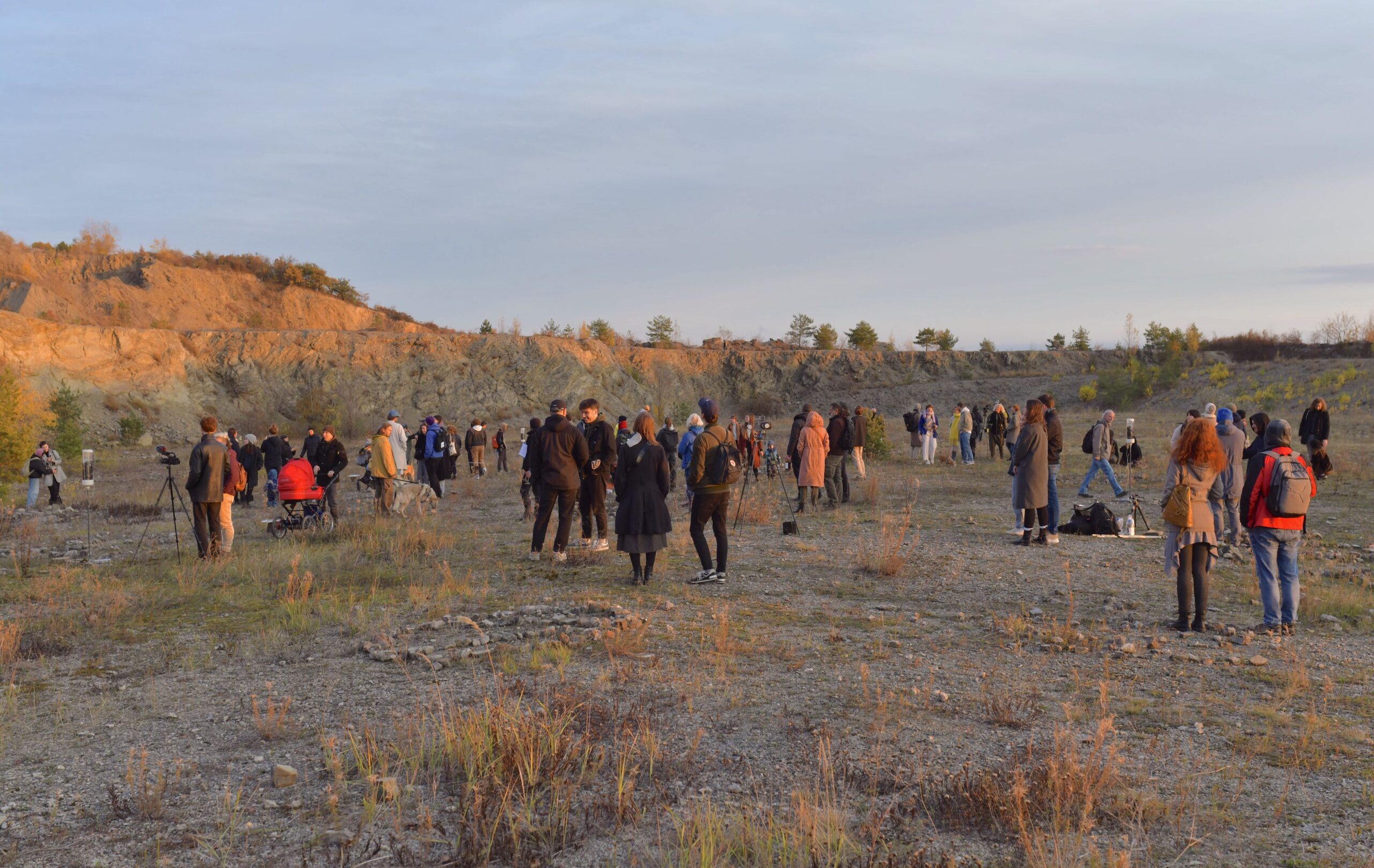
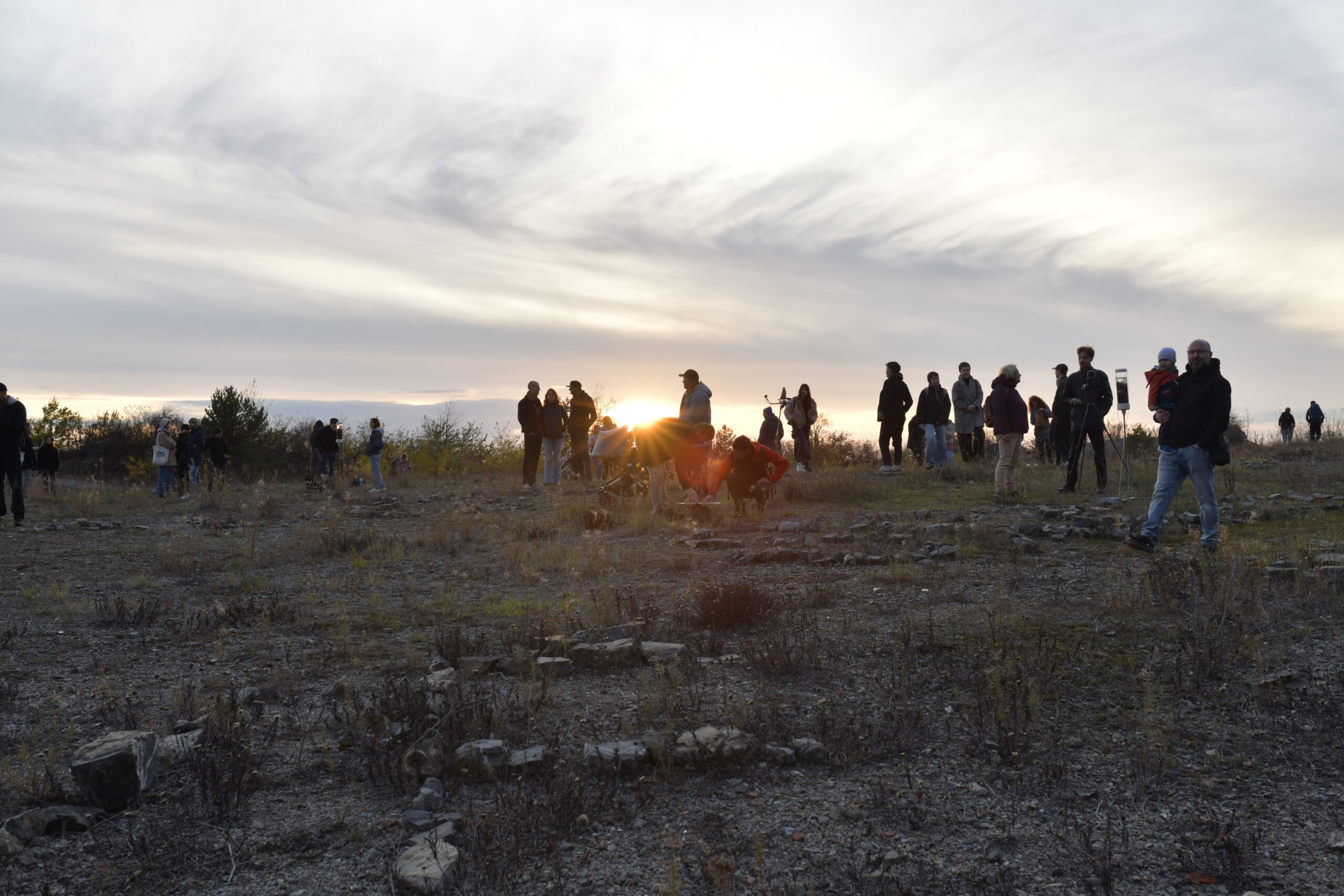
lom Hády, festival Sonda
about
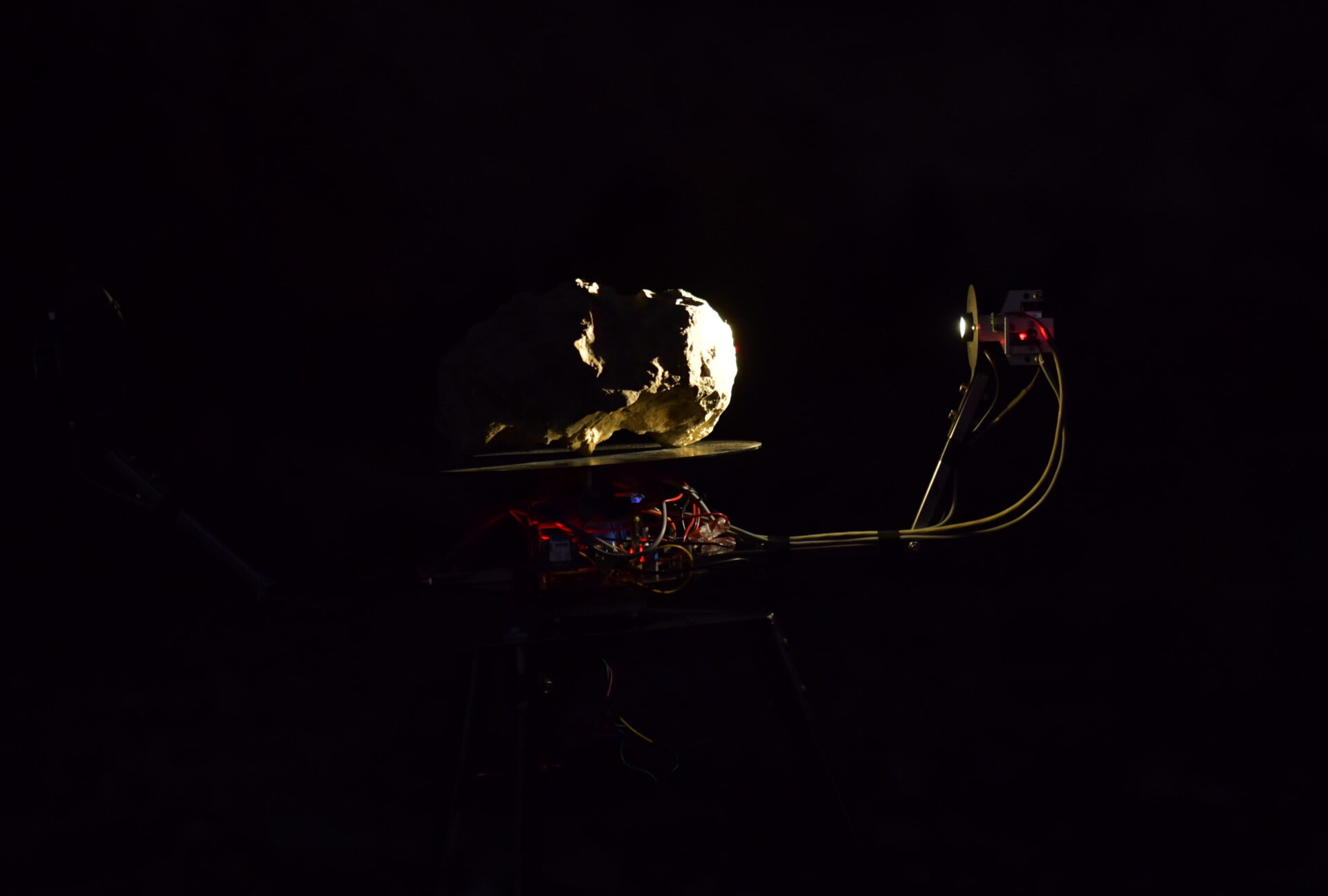
The sound installation Geofónie deals with the geological context of our surroundings – specifically, the limestone bedrock of the city Brno, which it presents in the form of sound, kinetic objects.
A series of objects creates an environment where visitors can contemplate the slow geological processes that shape our planet and our bodies. The planet has undergone many extreme situations, resulting in the formation of certain types of limestone, for example.
Various sounds of minerals, sonification of stone surfaces and amplification of speedup limestone dissolving…..
photo
material / technology
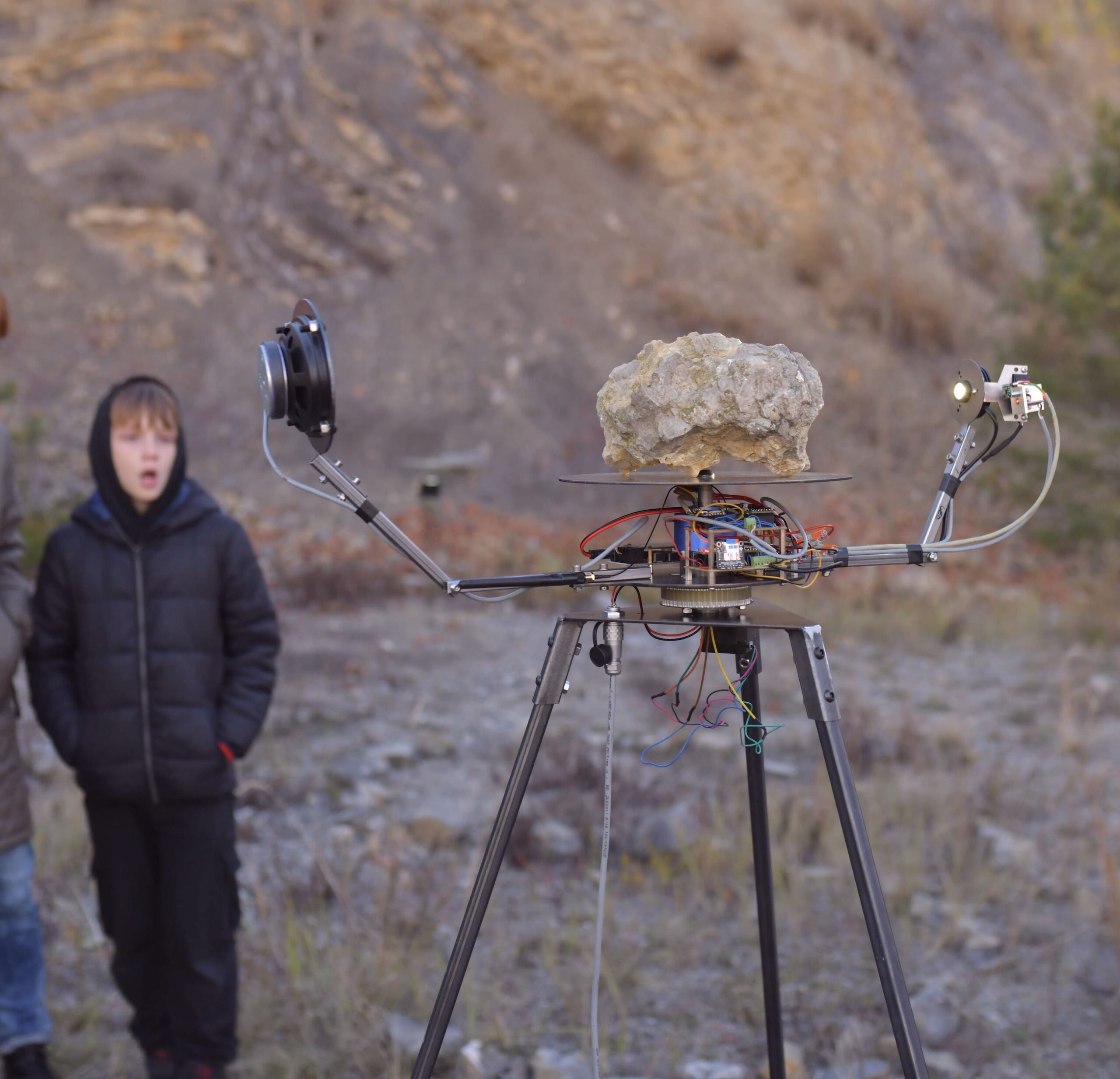
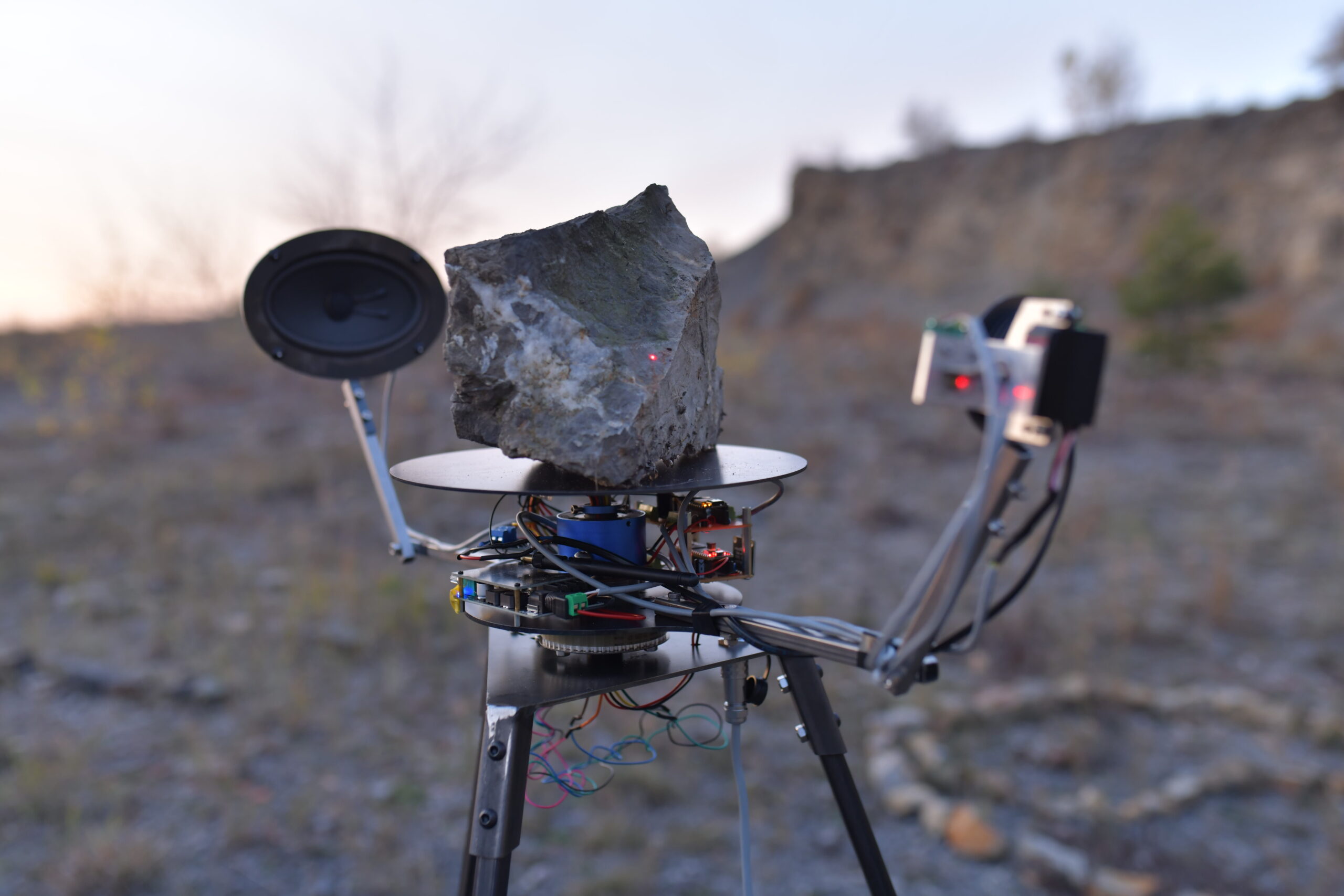
Materials / technology: stone, field recordings, steel, speaker, amplifier, laser, led, stepper + servo motors, slip ring, motor driver, ToF distance sensor, piezo, transducer, esp32, Daisy Seed, code (Gen~ + C)
description
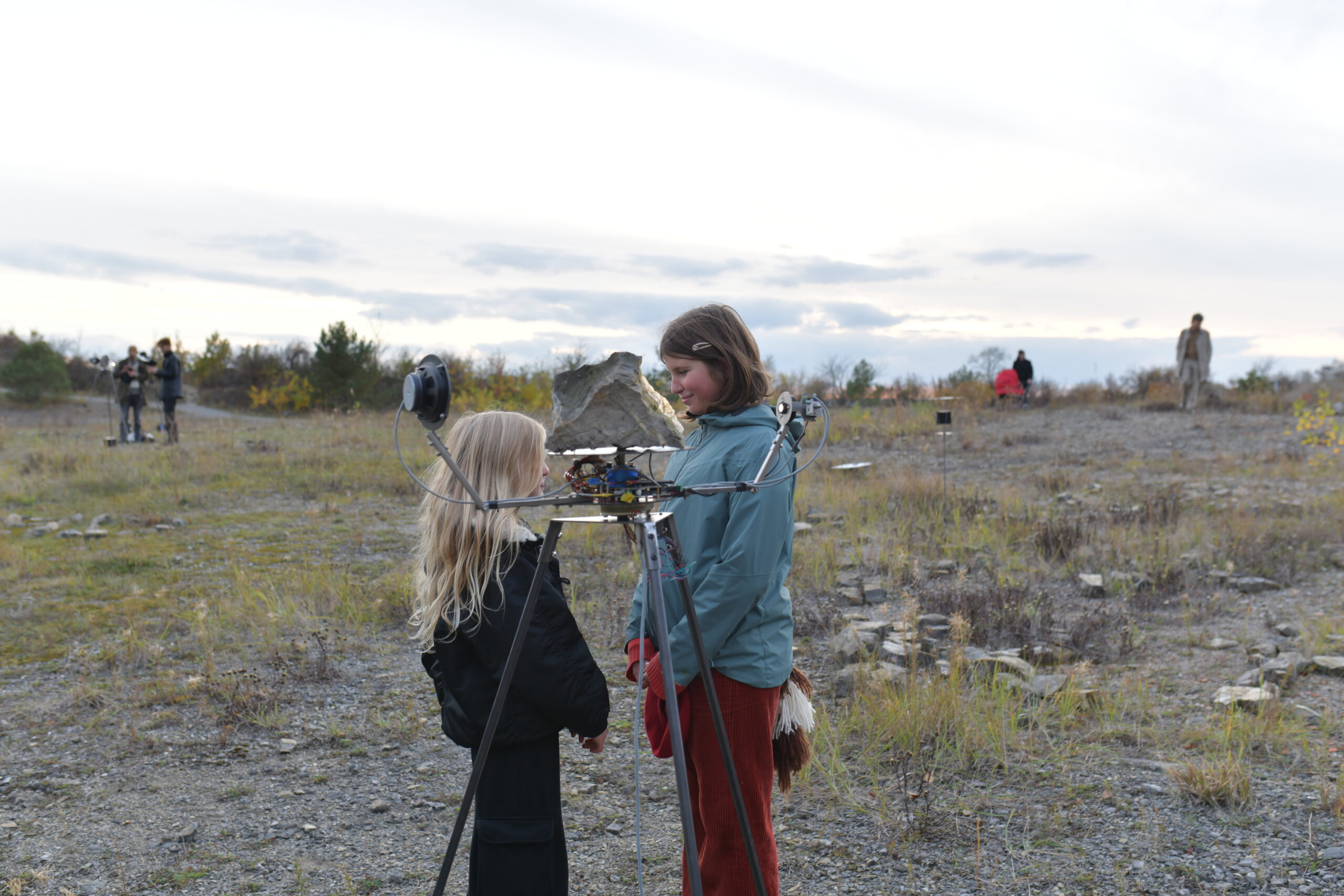
A) Kinetic scanners rotate around the stones, illuminating them and measuring their surface. Based on the distance measurements, granular synthesis of field recordings of limestones is modulated in real time. The sound is transmitted to a rotating speaker, creating a more complex spatial sound field.

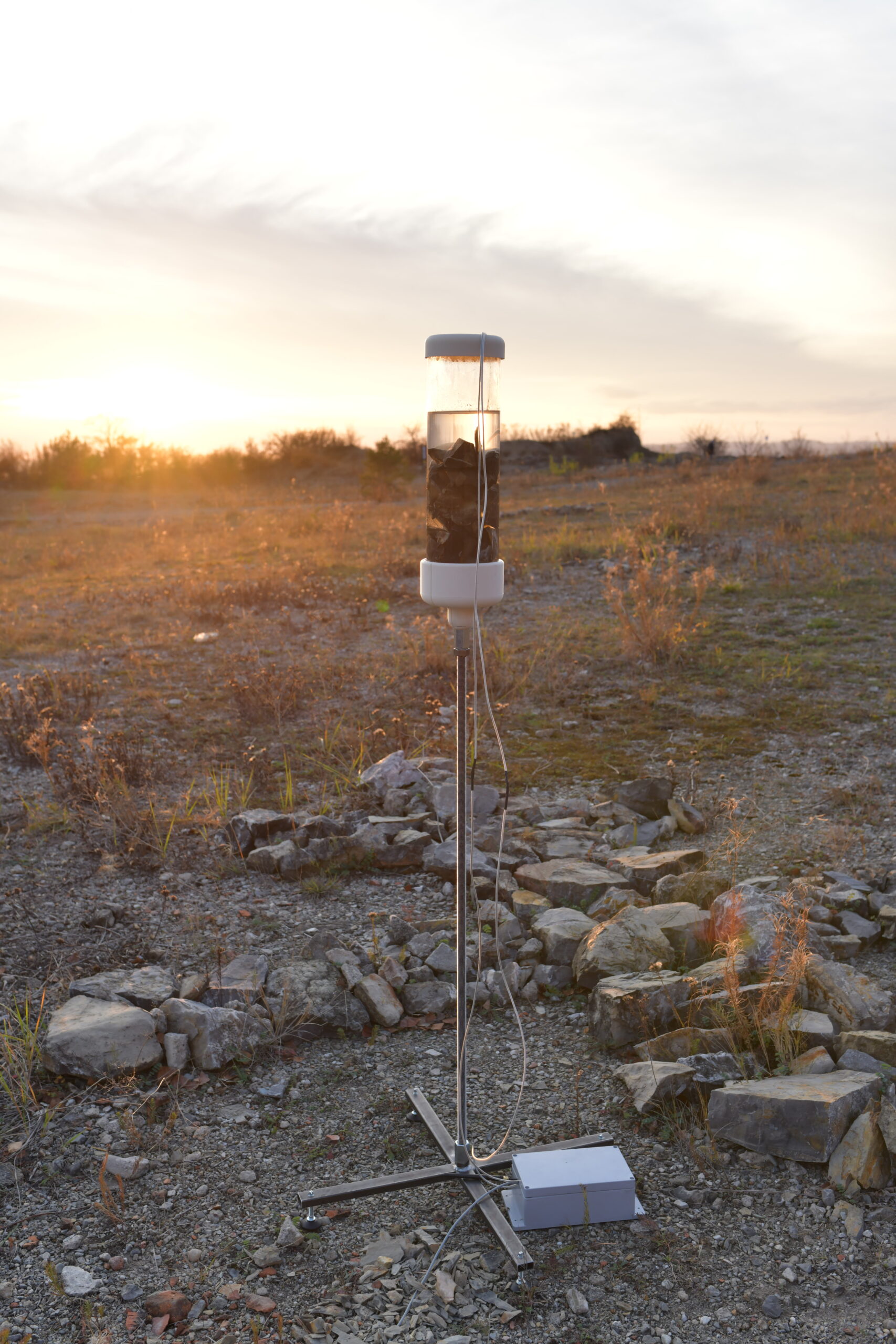
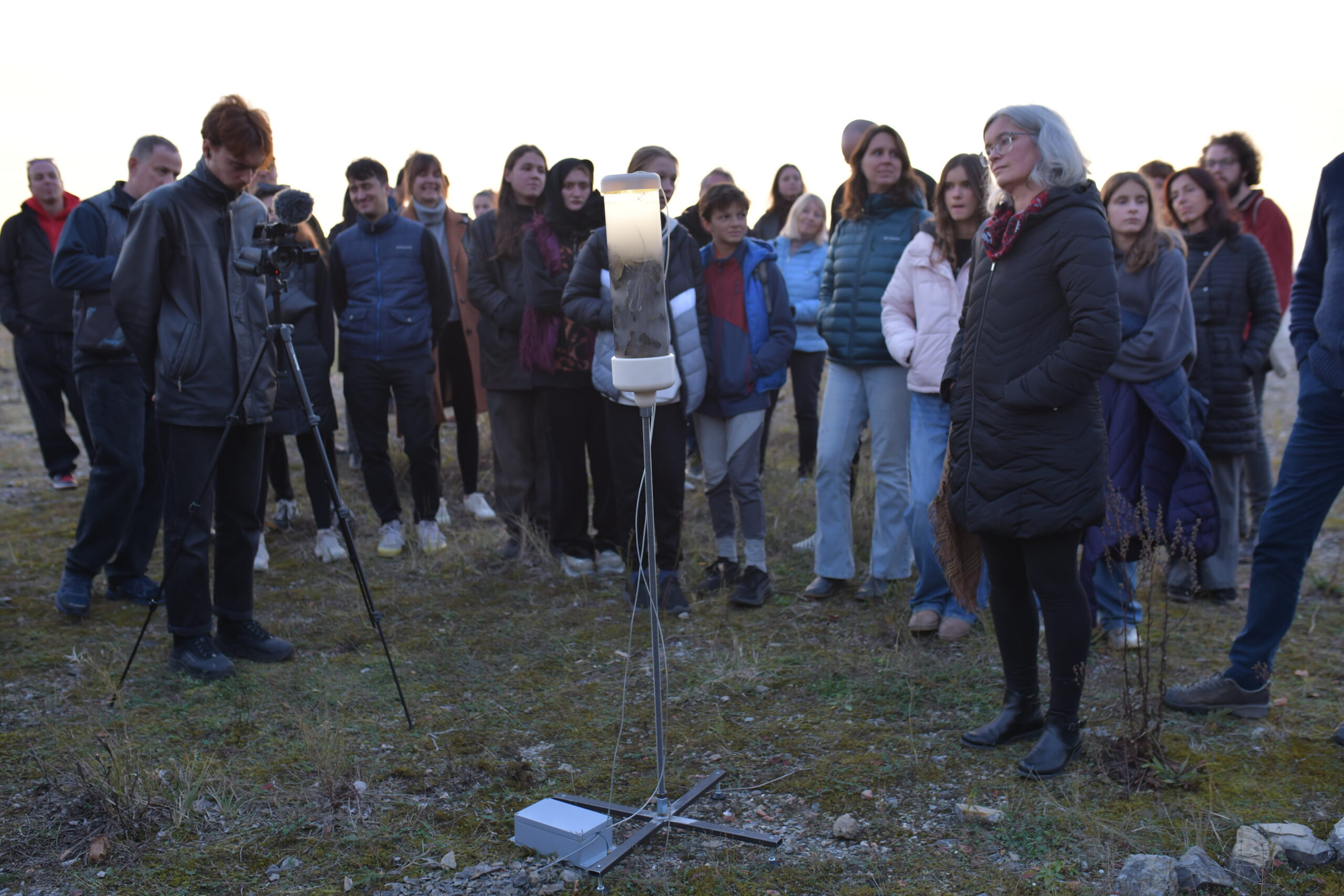
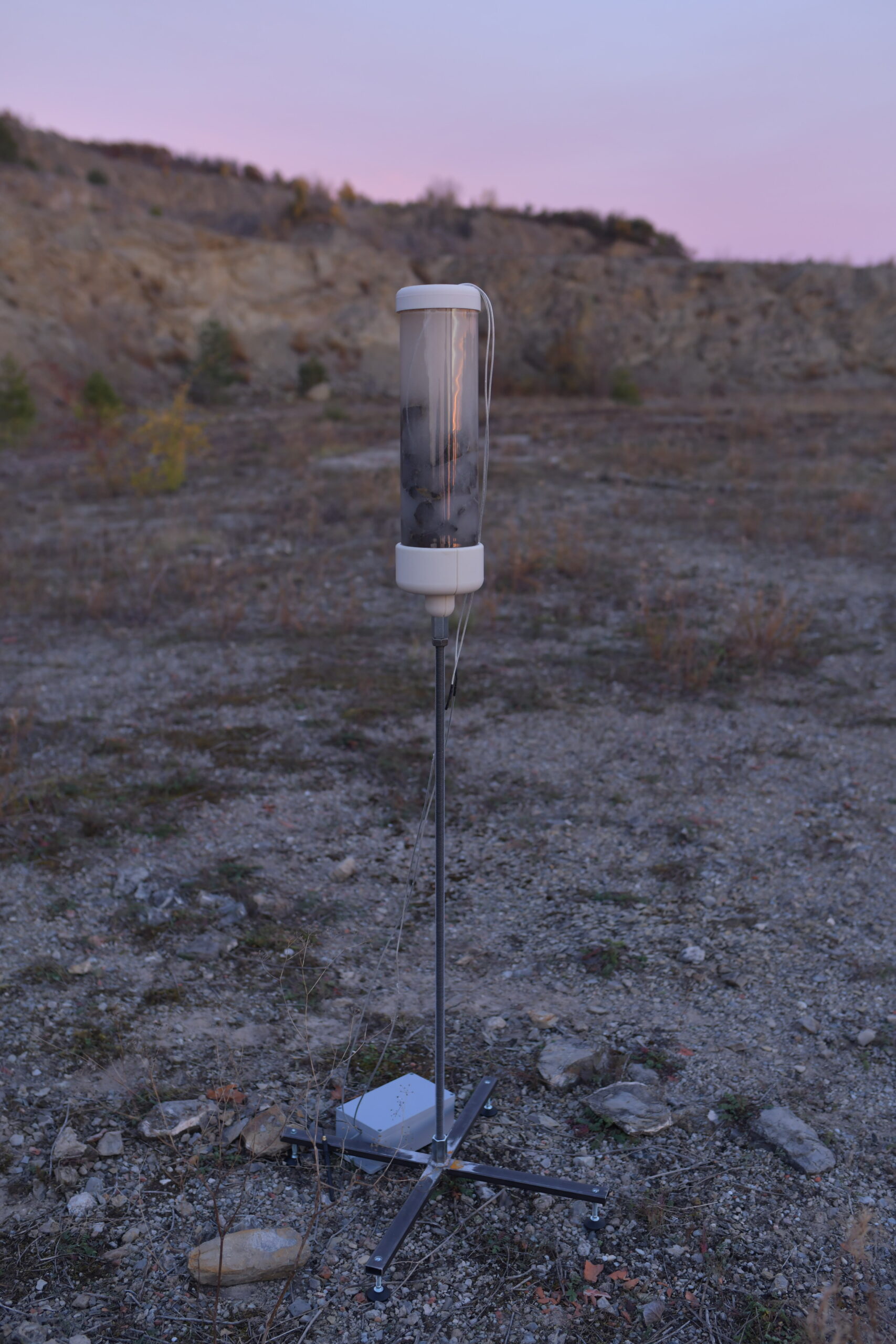
B) Limestone is slowly dissolved in acetic acid in glass luminescent cylinders. During this process, a subtle sound is produced, which is picked up by an underwater piezo contact microphone and further processed.
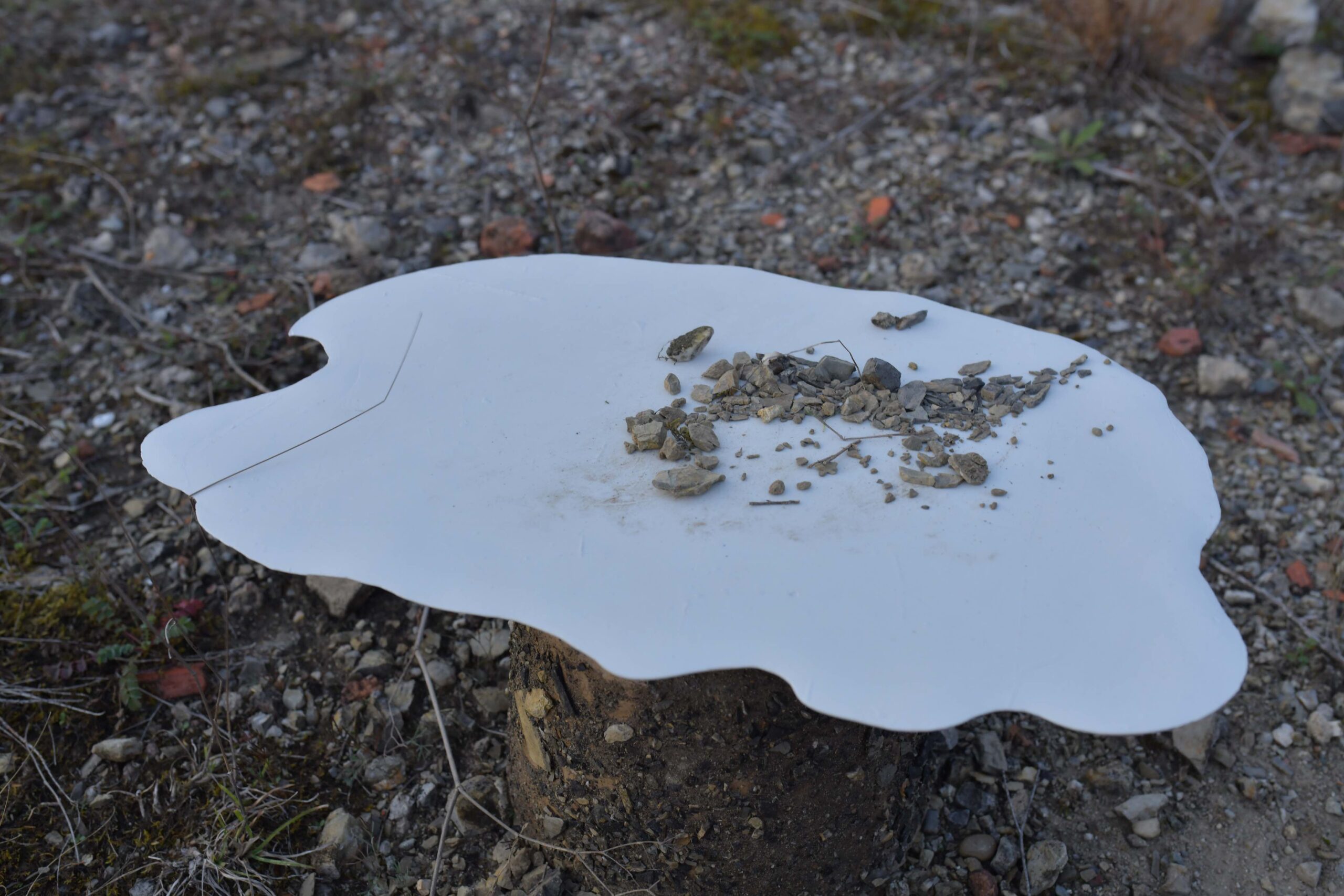
C) Porcelain plates of amorphous shapes serve as specific speaker membranes for sounds from objects B. On their surface are placed small stones that are moved and shifted by sound. The objects symbolize landslide platforms on which slow and fast sedimentation phenomena take place.
context
- Raymond Murray Schafer promotes the idea that the whole world can be perceived as one great symphony of sounds that we co-create. The Geofónie project offers the possibility of perceiving the world and its parts not as a symphony, but as a latent musical score. With the help of own apparatus and codes, we can subjectively read—interpret, in essence—any segment of measurable reality and transform it into a sensory experience. For Geofónie, limestone and puddingstone were selected from the artist’s living and working environment.
The project was originally created as a local, site-specific installation for the Hády quarry (Brno, Czech Republic). Outside the context of its original location, in the gallery, the stone brought along becomes the central theme – it becomes a “3D vinyl record.” Instead of a needle, an invisible laser beam from a ToF sensor is used.
Kinetic scanners rotate around the stones, illuminate them, and measure their surface. The sensor data is not played back directly, but is used as a source for modulation of parameters mapping granular synthesis sonification. The sound is transmitted to a rotating loudspeaker, creating a more complex spatial sound field. In this way, the temporal intersection in the exhibition combines the presence of contemporary technology with stones that were formed 380 to 360 million years ago.
Poetically/symbolically technology is not used to read the present, but also try to look into the distant past. Audience can listen to the history of our planet and the formation of rocks in imaginary way – underwater species extinctions alternating with explosions of life, areas of discontinuity, time gaps in measurements, gravitational turbidity currents of sediments, raging rivers bringing new fragments. One hypothesis for the causes of the first mass extinction (Ordovician-Silurian) was a higher concentration of calcium in the oceans. It was toxic to many soft-bodied organisms, which began to die out. Others, which were able to metabolize it, transformed and used calcium to build their spines, teeth, bones… We humans are their descendants, and limestone is compressed sediment from their bodies. This story of calcium thus prompts reflection on our perception of toxicity and adaptation.
gallery


credits
Jiří Y. Suchánek (CZ) – project director, kinetic objects, mechatronics, code, sound
Filip Dobrocký (SK) – code, wifi mesh, electronics, sound
Michal Marenčík (SK) – limestone dissolving objects, code, sound
Lucie Vobr Jestřabíková (CZ) – ceramics, porcelain, stone boxes
Eliška Janečková (CZ) – 3D prints, objects, speculative design
Mgr. Tomáš Kumpan, Ph.D. – geology expert consultant
Financial support: the Statutory City of Brno, the Ministry of Culture, Czech Republic
Realization at: SVITAVA – transmedia art lab, 2024; project TRYCHTÝŘ – interdisciplinární platforma pro vznik umění
video
exhibited
SONDA festival, Hády quarry, Brno, CZ, 11/2024
Brno Art Week, co.labs, Brno, CZ, 3/2025
Re:Senster lab, 3SI Art festival, Krakow, PL, 4/2025
Světlo Valmez, Valašské Meziříčí, CZ, 9/2025
Esc Medien Kunst Labor, Graz, AT 9-11/2025
Dim Zvuku (House of Sound), Lviv, Ukraine, 12/2025


